GUIDE HERE!

American Icon: The US Flag in Art
American Icon: The US Flag in Art brings together more than 30 works spanning the late 1800s to the present to trace the evolving meanings artists have attached to one of the United States’ most recognizable symbols. The exhibition is on view at the National Gallery of Art, East Building, 4th Street and Constitution Avenue NW, Washington, DC 20565, from June 6 to December 6, 2026.
American Icon: The US Flag in Art, a group exhibition featuring Faith Ringgold, Gordon Parks, Holly Bass, Sheila Pree Bright, Jasper Johns, and other artists, examines how the American flag has been used to express patriotism, protest, identity, inequality, and changing ideas of national belonging. National Gallery of Art, East Building, 4th Street and Constitution Avenue NW, Washington, DC 20565. Runs June 6–December 6, 2026.
Exhibition Description
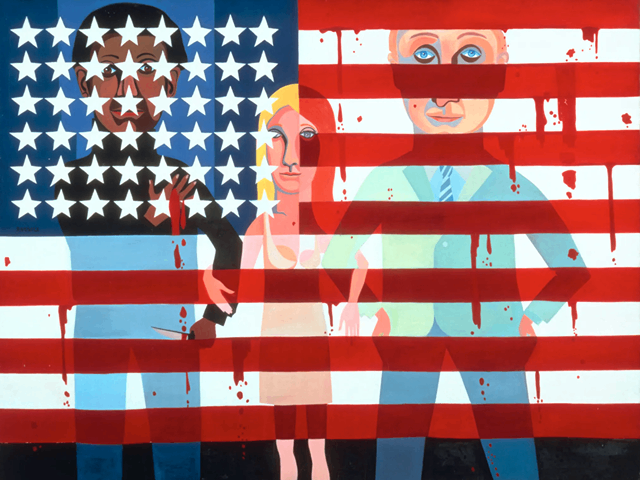
American Icon: The US Flag in Art, a group exhibition featuring Faith Ringgold, Gordon Parks, Holly Bass, Sheila Pree Bright, Jasper Johns, and other artists, examines how the American flag has been used to express patriotism, protest, identity, inequality, and changing ideas of national belonging. National Gallery of Art, East Building, 4th Street and Constitution Avenue NW, Washington, DC 20565. Runs June 6–December 6, 2026. The exhibition demonstrates how dramatically the meaning of the flag shifts according to who represents it and the historical moment in which it appears. Childe Hassam’s Allies Day, May 1917 (1917) celebrates the United States’ entry into World War I through a street filled with fluttering national flags, while photographs by Robert Frank and Dorothea Lange place the emblem within scenes of everyday American life and civic ritual. Jasper Johns approaches the flag as both familiar symbol and formal artistic object, while James Rosenquist’s Mirrored Flag (1971) transforms it through reflective foil and imagery connected to the Apollo lunar missions. Together, these works establish the flag as something simultaneously material, symbolic, public, and deeply personal. Black artists in the exhibition use that national imagery to address the gap between American ideals and Black lived experience. Faith Ringgold’s landmark The American People Series #18: The Flag is Bleeding (1967) embeds Black and white figures within a flag whose red stripes become streams of blood, confronting racial conflict during the civil rights era while responding in part to Jasper Johns’s earlier flag works. Gordon Parks’s Washington, D.C. Government Charwoman (American Gothic) places Ella Watson before the US flag with a broom and mop, turning a familiar national symbol into a critique of race, labor, and citizenship. The exhibition also includes Shawn Walker’s Untitled (Man with Flag) (c. 1965), Sheila Pree Bright’s photographs Charles Cauthen and Mari Agory (2008), and Holly Bass’s digital video American Woman (2021), extending the exhibition’s consideration. The exhibition demonstrates how dramatically the meaning of the flag shifts according to who represents it and the historical moment in which it appears. Childe Hassam’s Allies Day, May 1917 (1917) celebrates the United States’ entry into World War I through a street filled with fluttering national flags, while photographs by Robert Frank and Dorothea Lange place the emblem within scenes of everyday American life and civic ritual. Jasper Johns approaches the flag as both familiar symbol and formal artistic object, while James Rosenquist’s Mirrored Flag (1971) transforms it through reflective foil and imagery connected to the Apollo lunar missions. Together, these works establish the flag as something simultaneously material, symbolic, public, and deeply personal. Black artists in the exhibition use that national imagery to address the gap between American ideals and Black lived experience. Faith Ringgold’s landmark The American People Series #18: The Flag is Bleeding (1967) embeds Black and white figures within a flag whose red stripes become streams of blood, confronting racial conflict during the civil rights era while responding in part to Jasper Johns’s earlier flag works. Gordon Parks’s Washington, D.C. Government Charwoman (American Gothic) places Ella Watson before the US flag with a broom and mop, turning a familiar national symbol into a critique of race, labor, and citizenship. The exhibition also includes Shawn Walker’s Untitled (Man with Flag) (c. 1965), Sheila Pree Bright’s photographs Charles Cauthen and Mari Agory (2008), and Holly Bass’s digital video American Woman (2021), extending the exhibition’s consideratio