

Reckoning: Protest. Defiance. Resilience.
"Reckoning: Protest. Defiance. Resilience" explores the Black Lives Matter Movement, social protests, and the struggle for equality. The exhibition includes images and artwork by Jean-Michel Basquiat, Sheila Pree Bright, Bisa Butler, Shaun Leonardo, David Hammons, and more. Bisa Butler’s, I Go To Prepare A Place For You presents a quilt of multiple bright-colored cotton, silk, and velvet fabrics depicting Harriett Tubman seated against a dark floral background majestically gazing down at the viewer. The exhibit offers an augmented-reality experience, allowing visitors to use their mobile devices to connect the artwork with other objects and themes in the museum to create an interactive, immersive, digital experience. National Museum of African American History and Culture, 1400 Constitution Ave, NW, Washington, DC Ongoing.
Washington D.C.
North America


Fighters For Freedom: William H. Johnson Picturing Justice
"William H. Johnson (1901–1970) painted his last body of work, the Fighters for Freedom series, in the mid-1940s as a tribute to African American activists, scientists, teachers and performers as well as international leaders working to bring peace to the world. This landmark exhibition brings together—for the first time since 1946—34 paintings featured in the series.
The exhibition illuminates the extraordinary life and contributions of Johnson, an artist associated with the Harlem Renaissance but whose practice spanned several continents, as well as the contributions of historical figures he depicted. Some of his Fighters—Marian Anderson, George Washington Carver, Mohandas Gandhi, and Harriet Tubman—are familiar figures; others—Nannie Helen Burroughs and William Grant Still, among them—are less well-known individuals whose achievements have been eclipsed over time. Johnson celebrates their accomplishments even as he acknowledges the realities of racism, oppression, and sometimes violence they faced and overcame. Johnson clues viewers to significant episodes in the Fighters lives by punctuating each portrait with tiny buildings, flags, and vignettes that give insight into their stories. Using a colorful palette to create evocative scenes and craft important narratives, he suggests that the pursuit of freedom is an ongoing, interconnected struggle, with moments of both triumph and tragedy."
Washington D.C.
North America

Basquiat × Banksy
"Basquiat × Banksy marks the first time that artwork by either artist has been presented at the nation’s museum of modern and contemporary art. The exhibition also includes 20 small works on paper and wood from the collection of Larry Warsh that were made by Basquiat between 1979 and 1985 and demonstrate the artist’s deep familiarity with art history, his use of language, and his signature motifs, such as skulls and crowns. The film Downtown 81 (shot in 1980–1981 and released in 2000), a send-up of the denizens of Manhattan’s ’80s avant-garde that stars Basquiat as a struggling artist named “Jean,” will also be on view." -Press release
Washington D.C.
North America

Spirit & Strength: Modern Art from Haiti
Washington D.C.
North America

Adam Pendleton: Love, Queen
Adam Pendleton is renowned for his distinctive and conceptually rigorous paintings that blur the lines between painting, drawing, and photography. His process involves starting with paper compositions featuring drips, splatters, geometric shapes, words, and phrases, which he then photographs and layers using a screen-printing technique. This exhibition features several of Pendleton's significant series, including Black Dada, Days, WE ARE NOT, and new Composition and Movement paintings. Additionally, the exhibition debuts Resurrection City Revisited (Who Owns Geometry Anyway?), a new video work projected floor to ceiling. This piece incorporates still and moving images of Resurrection City, the 1968 encampment on the National Mall associated with Martin Luther King Jr.'s Poor People's Campaign, interspersed with found footage and geometric forms, accompanied by a score from composer Hahn Rowe.
Washington D.C.
North America

Lessons of the Hour
Julien’s cinematic installation interweaves reenactments of Douglass’s life, inspired by his speeches such as “What to the Slave is the Fourth of July?” and “Lecture on Pictures.” It connects historical and contemporary imagery, from 19th-century photography studios to modern scenes in Baltimore and D.C., emphasizing Douglass’s belief in photography as a tool for liberation and justice. The rich visuals and layered soundscape invite viewers to reflect on both the legacy of Douglass and the broader fight for racial equality. Julien’s poetic editing style makes this a meditative and moving experience that resonates deeply with contemporary issues.
Washington D.C.
North America
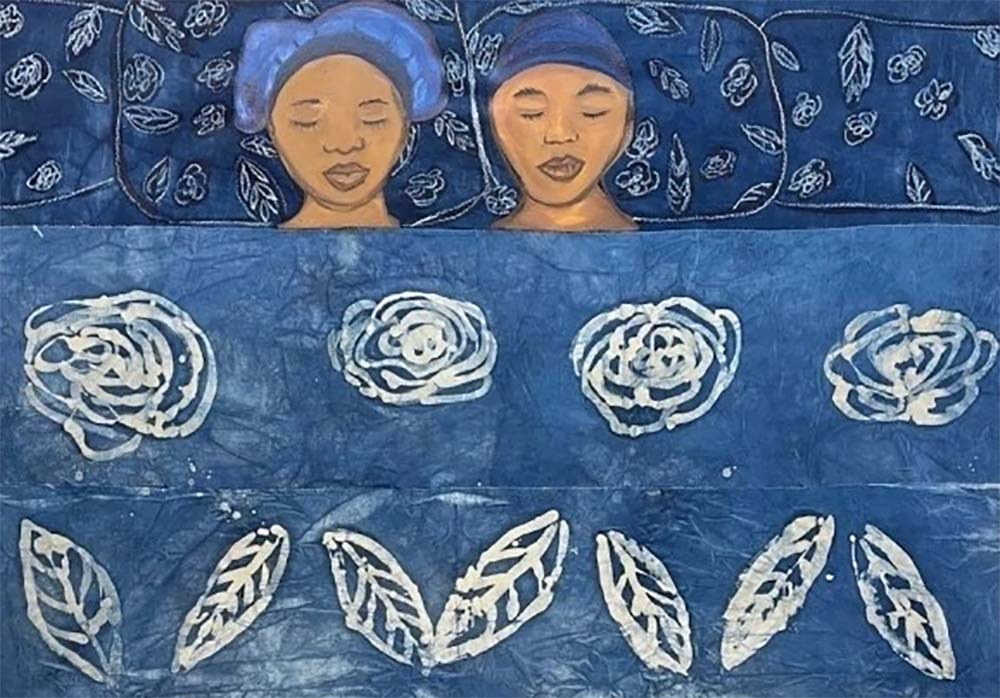
Here: Pride and Belonging in African Art
Here: Pride and Belonging in African Art presents a dynamic selection of artworks that foreground the ways African artists articulate belonging—whether rooted in geography, cultural heritage, community, or selfhood. Spanning a range of mediums including painting, sculpture, photography, textiles, and mixed media, the exhibition reflects the diversity of artistic strategies used to express pride and connection across time and place.
The exhibition considers how artists respond to social, political, and historical forces while affirming presence and agency. Works explore themes such as home, migration, memory, language, spirituality, and cultural continuity, offering perspectives that resist singular narratives of African identity. Rather than framing belonging as fixed, the exhibition emphasizes it as relational and evolving.
Organized by the Smithsonian National Museum of African Art, Here: Pride and Belonging in African Art situates contemporary artistic production within broader conversations about identity, representation, and cultural affirmation. The exhibition invites viewers to consider how art functions as a site of self-recognition and collective pride. Here is on view through August 23, 2026, at the Smithsonian National Museum of African Art, Washington, DC.
Washington D.C.
North America
American Icon: The US Flag in Art
American Icon: The US Flag in Art, a group exhibition featuring Faith Ringgold, Gordon Parks, Holly Bass, Sheila Pree Bright, Jasper Johns, and other artists, examines how the American flag has been used to express patriotism, protest, identity, inequality, and changing ideas of national belonging. National Gallery of Art, East Building, 4th Street and Constitution Avenue NW, Washington, DC 20565. Runs June 6–December 6, 2026.
The exhibition demonstrates how dramatically the meaning of the flag shifts according to who represents it and the historical moment in which it appears. Childe Hassam’s Allies Day, May 1917 (1917) celebrates the United States’ entry into World War I through a street filled with fluttering national flags, while photographs by Robert Frank and Dorothea Lange place the emblem within scenes of everyday American life and civic ritual. Jasper Johns approaches the flag as both familiar symbol and formal artistic object, while James Rosenquist’s Mirrored Flag (1971) transforms it through reflective foil and imagery connected to the Apollo lunar missions. Together, these works establish the flag as something simultaneously material, symbolic, public, and deeply personal.
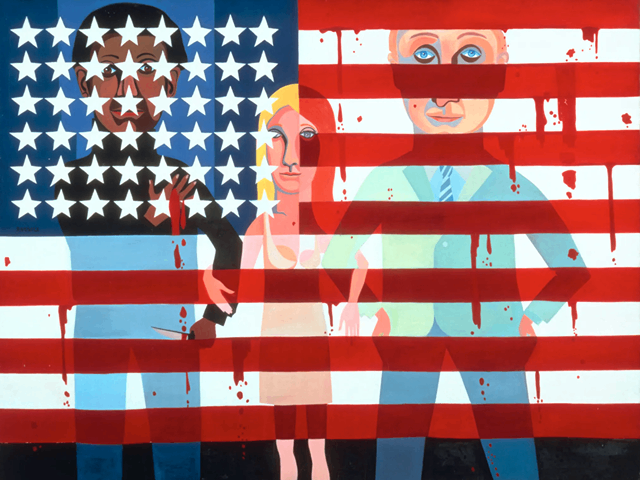
Black artists in the exhibition use that national imagery to address the gap between American ideals and Black lived experience. Faith Ringgold’s landmark The American People Series #18: The Flag is Bleeding (1967) embeds Black and white figures within a flag whose red stripes become streams of blood, confronting racial conflict during the civil rights era while responding in part to Jasper Johns’s earlier flag works. Gordon Parks’s Washington, D.C. Government Charwoman (American Gothic) places Ella Watson before the US flag with a broom and mop, turning a familiar national symbol into a critique of race, labor, and citizenship. The exhibition also includes Shawn Walker’s Untitled (Man with Flag) (c. 1965), Sheila Pree Bright’s photographs Charles Cauthen and Mari Agory (2008), and Holly Bass’s digital video American Woman (2021), extending the exhibition’s consideration. The exhibition demonstrates how dramatically the meaning of the flag shifts according to who represents it and the historical moment in which it appears. Childe Hassam’s Allies Day, May 1917 (1917) celebrates the United States’ entry into World War I through a street filled with fluttering national flags, while photographs by Robert Frank and Dorothea Lange place the emblem within scenes of everyday American life and civic ritual. Jasper Johns approaches the flag as both familiar symbol and formal artistic object, while James Rosenquist’s Mirrored Flag (1971) transforms it through reflective foil and imagery connected to the Apollo lunar missions. Together, these works establish the flag as something simultaneously material, symbolic, public, and deeply personal.
Black artists in the exhibition use that national imagery to address the gap between American ideals and Black lived experience. Faith Ringgold’s landmark The American People Series #18: The Flag is Bleeding (1967) embeds Black and white figures within a flag whose red stripes become streams of blood, confronting racial conflict during the civil rights era while responding in part to Jasper Johns’s earlier flag works. Gordon Parks’s Washington, D.C. Government Charwoman (American Gothic) places Ella Watson before the US flag with a broom and mop, turning a familiar national symbol into a critique of race, labor, and citizenship. The exhibition also includes Shawn Walker’s Untitled (Man with Flag) (c. 1965), Sheila Pree Bright’s photographs Charles Cauthen and Mari Agory (2008), and Holly Bass’s digital video American Woman (2021), extending the exhibition’s consideratio
Washington D.C.
North America